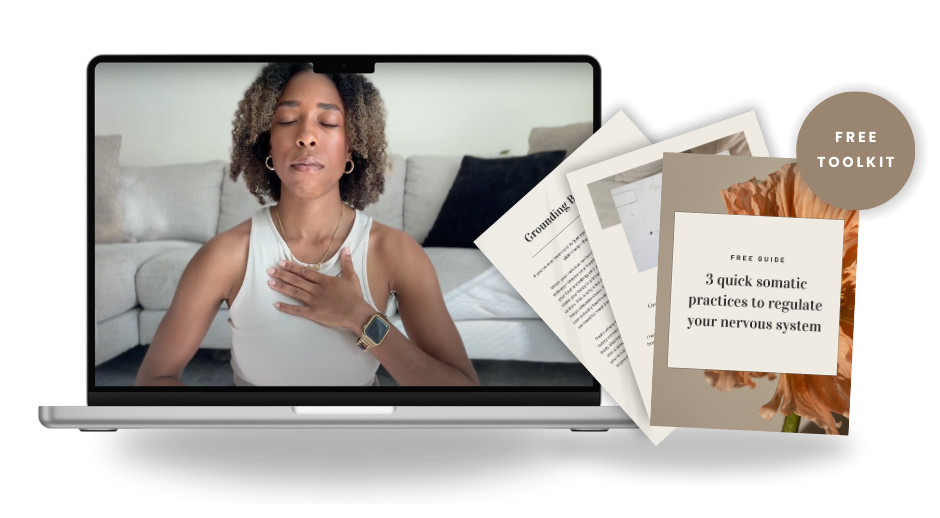
5 somatic therapy exercises you can use between sessions to regulate your nervous system
There's a particular kind of exhaustion that doesn't go away with sleep. You wake up already braced for the day. Your shoulders are tight before you've even checked your phone. Your mind is moving faster than your body can keep up with, and somewhere in the middle of all of it, you've lost the thread back to yourself. If that sounds familiar, you're not alone, and you're not broken. Your nervous system has been working overtime to keep you safe, and what it needs now isn't more pushing through. It needs practice coming back down.
Somatic therapy exercises are one of the most accessible ways to support that process. They don't require a therapist in the room. They don't require a special space or a perfect moment. They require your body, your breath, and a few minutes of intentional attention. As someone who works with women navigating chronic stress, stored trauma, and the particular weight of carrying too much for too long, these are the practices I return to again and again , both in session and between them.
In case you're new here , I'm Chelsey Reese, and I support women, especially women of color, in coming back home to themselves through body-based healing. If you want to understand more about my approach, you can visit my somatic-based wellness services. To explore working together, learn more about somatic therapy at Power Through Process.
Below are five somatic therapy exercises you can start using today, between sessions, in the middle of a hard day, or whenever your body is asking you to slow down and listen.
Do somatic exercises work?
Before we get into the exercises themselves, I want to address this question honestly , because it's one I hear often, and it deserves a real answer.
Yes. Somatic exercises work. But not the way we're used to thinking about "working." They don't produce dramatic, immediate transformation. What they do is create small, consistent shifts in how your nervous system responds to stress over time. Think of it like physical therapy for your nervous system. One session of stretching doesn't undo years of tension. But practiced regularly, the body begins to remember a different baseline.
The research supports this. Somatic approaches have been shown to reduce symptoms of PTSD, anxiety, and chronic stress by working directly with the autonomic nervous system , the part of your body that regulates your stress response below conscious thought. When you practice somatic exercises consistently, you're not just calming yourself in the moment. You're teaching your nervous system that safety is available. That rest is possible. That you don't have to stay braced forever.
For women who have spent years in survival mode , emotionally suppressed, chronically overextended, disconnected from their own needs , that teaching is not small. It's everything.
Can I do somatic healing on my own?
Somatic healing is most powerful within a therapeutic relationship. Having a trained therapist present means someone is tracking your nervous system responses, helping you stay regulated when something intense surfaces, and guiding the work at a pace that's safe for your system. That container is real, and it makes a difference.
That said , yes, you can practice somatic exercises on your own, and doing so is genuinely valuable. The exercises in this post are designed to be safe for independent practice. They are not trauma processing. They are nervous system support. Think of them as the daily habits that keep your system more regulated between sessions, the same way stretching supports your body between workouts.
If you find that any of these exercises bring up intense emotions or memories, that's not a sign to push through , it's a signal to slow down, return to something grounding, and bring it to your next session. Your body's wisdom includes knowing when it needs support.

Exercise 1: Extended exhale breathing
This is the exercise I recommend first to almost everyone, because it works immediately and it works through biology. The exhale activates the parasympathetic nervous system , the branch responsible for rest, digestion, and recovery. When your exhale is longer than your inhale, you are literally signaling to your body that the threat has passed and it's safe to slow down.
Here's how to practice it. Inhale slowly through your nose for a count of four. Exhale slowly through your mouth for a count of eight. If eight feels too long, start with six , the ratio matters more than the number. Repeat for five to ten cycles. You don't need to force relaxation or control what you feel. Just let the breath do its work and notice what shifts.
This exercise is particularly useful when you're feeling flooded , overwhelmed, anxious, or like your thoughts are moving faster than you can catch them. It's also useful when you feel shut down or numb, because it gently reactivates sensation without pushing too hard. You can do it sitting at your desk, in your car before walking into a hard meeting, or lying in bed when sleep won't come. Two minutes is enough to feel a difference. Ten minutes changes the tone of your whole nervous system.
Exercise 2: Grounding through the feet
When anxiety pulls you out of the present moment , into the future, into the past, into the spiral , your feet are one of the fastest ways back. This exercise uses the physical weight and pressure of your body against the ground to interrupt a stress response and orient your nervous system to where you actually are: here, now, safe.
Sit in a chair with both feet flat on the floor. Press them down firmly , not tensed, but grounded. Notice the pressure. Notice the temperature of the floor through your shoes or your skin. Slowly start to notice the weight of your body in the chair. Feel where you make contact , your legs, your back, your seat. Take one slow breath and look around the room. Name five things you can see out loud or in your mind. Then bring your attention back to your feet and take three more slow exhales.
This is what somatic therapists call orienting , giving your nervous system concrete, present-moment information to organize around. When your system is dysregulated, it's often because it's responding to something that isn't happening right now. Grounding gives it something real to hold onto. The relief is often immediate, even if subtle. And subtle is enough.
Exercise 3: The body scan
A body scan is one of the foundational somatic therapy exercises because it builds the most essential skill in somatic healing: the ability to notice what's happening in your body without immediately trying to fix, escape, or judge it. For many of us , especially those who have learned that emotions weren't safe to feel , this skill has to be practiced. It doesn't come automatically. But it comes.
Find a comfortable position, seated or lying down. Close your eyes if that feels safe, or soften your gaze toward the floor. Begin at the top of your head and slowly move your awareness downward , your forehead, your jaw, your throat, your shoulders, your chest, your belly, your lower back, your hips, your thighs, your calves, your feet. At each area, pause for one or two breaths and simply notice. Is there tension? Warmth? Tightness? Ease? Numbness? You're not trying to change anything. You're listening.
What you're looking for over time is body literacy , the ability to read your own internal signals before they escalate into full stress responses. The jaw that tightens before you know you're anxious. The chest that closes before you know you're hurt. The belly that knots before you know you're scared. These sensations are your body's language. The body scan teaches you to hear it early, when there's still room to respond rather than react.
Exercise 4: Shaking and intentional movement
This one tends to get the most skeptical looks , and I understand why. We're not used to thinking of shaking as healing. We're used to suppressing it, pushing it down, apologizing for it. But shaking is one of the nervous system's most natural mechanisms for discharging stored stress energy. Animals do it instinctively after a threat passes. Humans have learned to override it. Somatic therapy invites us to stop overriding.
You can practice this intentionally. Stand with your feet hip-width apart. Soften your knees slightly so they have a gentle bend. Begin to bounce lightly , just enough to let your body start to vibrate. Let the movement travel up through your legs, your hips, your belly, your chest. You're not forcing a shake. You're creating the conditions for one. Stay with it for two to three minutes, breathing naturally. When you stop, stand still and notice what you feel. Warmth, tingling, a sense of release, or even a spontaneous exhale , those are signs of discharge.
If spontaneous shaking arises during this exercise or any other somatic practice, let it happen. Don't grip it, don't amplify it , just let it move through. It won't last forever. And when it completes, your nervous system will be lighter for it.
Exercise 5: Havening touch
Havening is a somatic technique that uses gentle, repetitive self-touch to generate delta waves in the brain , the same waves associated with deep sleep and emotional processing. It's been studied for its effects on anxiety, trauma, and stress, and it's one of the most immediately soothing somatic exercises available for at-home practice.
Here's how it works. Using both hands, stroke slowly down your upper arms from shoulder to elbow, as if you're brushing something gently off your skin. Then bring your palms to your face and stroke slowly from your forehead down over your eyes and cheeks. Finally, place your hands on your collarbones and stroke outward toward your shoulders. Repeat this sequence slowly, two or three times through, while taking slow breaths. Some people add a gentle humming or a calming phrase , something simple like "I am here, I am safe."
The combination of touch, rhythm, and breath creates a powerful signal of safety in the nervous system. It's particularly useful when you're feeling emotionally flooded, overstimulated, or untethered. For women who have spent years disconnected from their bodies, this kind of gentle, intentional self-touch can also be a practice in learning to treat your own body with care , which is its own form of healing.
Is walking a somatic exercise?
Yes , when it's done with intention. Walking is one of the most natural bilateral movements the body makes, meaning it activates both sides of the body and brain in an alternating rhythm. That bilateral stimulation has a regulating effect on the nervous system, which is part of why a walk can feel so clarifying when your mind is overwhelmed.
The difference between a regular walk and a somatic walk is attention. Instead of walking while scrolling, listening to a podcast, or mentally rehearsing your to-do list, a somatic walk asks you to slow down and notice. Feel the ground under each foot. Notice the rhythm of your breath. Observe what you see, hear, and smell without labeling or analyzing. Let your arms swing naturally. Let your jaw soften. Let your shoulders drop.
Even ten minutes of this kind of intentional, body-present walking can shift your nervous system state. It's not a replacement for somatic therapy, but it is a somatic practice , one that's available to you every day, as many times as you need it.
Your body already knows how to heal
Everything in this post is pointing toward the same truth: your body is not the problem. It has been doing its best to protect you, sometimes for decades, and it carries the evidence of everything you've survived. Somatic therapy exercises are a way of working with that body , not against it. Of meeting it where it is, with patience and curiosity, and gently teaching it that safety is available now.
If you're ready to go deeper , to do this work within a held, therapeutic relationship , I'm here. I offer
somatic therapy in Los Angeles rooted in somatic and body-based healing.

Hello, I’m Chelsey Reese
Licensed Clinical Social Worker, Relational and Somatic Therapist, Certified Sound Healer, and 200HR Registered Yoga Teacher. .
I help people cultivate self-awareness by reconnecting with their bodies, releasing trauma and stress, and fostering deeper connections. I believe true healing comes from processing lived experiences and letting go of what no longer serves us.
Passionate about community and wellness, I create spaces for growth and restoration. When I’m not working with clients, you’ll find me tending to my plants, lost in a book, or hiking in nature.