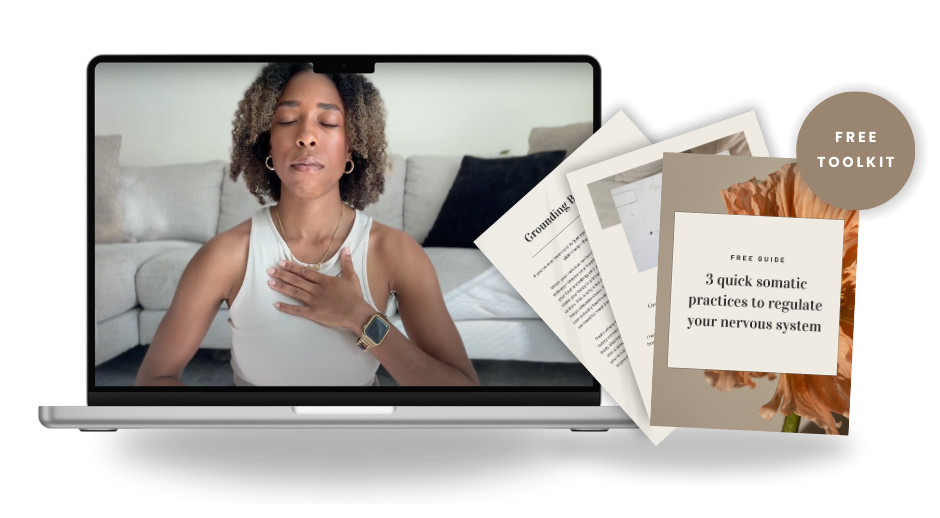
How online somatic therapy works and why it's just as effective as in person
Most people who search for somatic therapy online are already carrying a quiet doubt: how can a therapy that is all about the body possibly work through a screen? It is a fair question, and it deserves a real answer instead of a sales pitch. Somatic therapy asks you to notice what is happening inside you, sensation by sensation, and then lets your nervous system do what it was built to do. That noticing does not require the two of us to be in the same room. It requires your attention, your willingness, and a guide who knows how to slow things down.
If you are the person everyone leans on, the one who holds the family together and still shows up to every meeting with a smile, you probably already know your body is keeping a tally. The tight jaw. The shoulders that live up by your ears. The exhaustion that sleep does not touch. Online somatic therapy was made for exactly the kind of life that leaves no room for a commute across town.
In this post I will walk you through what online somatic therapy actually is, how a session unfolds over video, whether it holds up against in-person work, how it differs from EMDR, what you can practice on your own between sessions, and how to find the right therapist for you.
In case you are new here, I am Chelsey Reese, and I offer somatic therapy for Black women and women of color, helping high-achieving women who have spent years in survival mode come back home to their bodies with grounding, soul-centered care. I work with women who have already tried thinking their way out of exhaustion and are ready to try feeling their way through it instead, wherever they happen to be sitting.
What is online somatic therapy?
Online somatic therapy is body-based psychotherapy delivered over a secure video call. Instead of centering the conversation on what you think about your life, it centers on what you feel in your body while you talk about it. The lump in your throat when a certain topic comes up. The way your breath shortens when you describe your boss. The heaviness that settles into your chest on Sunday nights. In somatic therapy, those sensations are not background noise. They are the actual material we work with.
The word somatic simply means "of the body." The premise is that stress and trauma are not stored as tidy memories in the mind. They live in the nervous system as patterns of bracing, holding, and shutting down, and those patterns keep running long after the original event is over. Talk therapy helps you understand why you feel the way you do. Somatic therapy helps your body finally stop bracing.
Online, all of that happens exactly as it would in an office. You sit somewhere comfortable, we talk, and as sensations arise I invite you to slow down and notice them. I might ask you what you feel in your belly right now, or whether your feet can feel the floor, or what happens in your chest when you say that sentence out loud. The screen carries your voice, your face, and your words. Your body is right there with you, which is the only place it ever needed to be.
What you actually need to get started
Women often assume online somatic work requires a special setup. It does not. What helps most is simple:
- A private space where you will not be interrupted for an hour, even if that means the car in the driveway or the bedroom with the door locked
- A device with a camera positioned so I can see your face and at least your shoulders, since so much of what I track lives in your breath and posture
- Headphones, if you share walls, so you can speak freely without editing yourself
- Something comforting within reach: a blanket, a glass of water, a pillow to hold
That is it. You do not need to be calm, prepared, or articulate about what is wrong. You need to show up as you are, and the work meets you there.
How does somatic therapy work over video?

The techniques that make somatic therapy effective translate cleanly to video because none of them depend on me physically touching you or being in the same space. They depend on your awareness and my ability to track what is happening for you and pace the work accordingly. Two of the core practices, grounding and titration, actually gain something from being done at home. If you would like a picture of how a full session unfolds from the first minute to the last, I walk through it in what to expect in a somatic therapy session.
Grounding and orientation: using your own space as a resource
Grounding is the practice of bringing your attention into the present moment through your body and your surroundings. Orientation is the gentle act of looking around and letting your nervous system register that you are safe right now, in this room, in this chair. In an office, the room is mine. Online, the room is yours.
That matters more than it sounds. When I ask you to notice three things you can see, or to feel the weight of your body in the chair, you are anchoring into a space you already know. Your own blanket, your own window, the plant you have kept alive for two years. For women who have learned to stay on guard everywhere they go, there is something powerful about doing this work somewhere the guard can drop a little. Your living room becomes part of the therapy, and the sense of safety you build there is available to you every single day, not just during our hour together.
Titration and pendulation: why going slow is the point
Titration is a word borrowed from chemistry. It means adding something one drop at a time so nothing overflows. In somatic therapy, it means we approach difficult material in small, manageable doses rather than diving into the deep end. Pendulation is the natural rhythm of moving between activation and settling, between a place in your body that feels tight and a place that feels neutral or even good.
Over video, I watch your face, your breathing, your posture, and I listen to your voice for the shifts that tell me your system is getting close to its edge. Then we slow down. We come back to your feet, your breath, the sensation of your hands resting on your thighs. This is not avoidance. It is how the nervous system learns that it can touch something painful and come back to steadiness. Every time you pendulate back to calm, your body gets a little more evidence that it can survive feeling.
The screen does not get in the way of this. If anything, the slightly slower pace of video conversation supports it. There is a natural half second of space online that invites both of us to pause, and pausing is where the work lives.
Is online somatic therapy as effective as in person?
For most people, yes. Somatic therapy is built on interoception, which is your ability to sense what is happening inside your body. Interoception is not something I do to you. It is something you do, with guidance. Whether I am sitting across from you or looking at you through a screen, the sensation in your chest is still yours to notice, and the settling that follows is still your nervous system doing its work.
What in-person sessions offer that video does not
In-person sessions offer the option of therapeutic touch, and a shared physical space that some people find easier to relax into. For some clients, particularly those working through severe dissociation, that in-person container can be helpful, and I will always tell you honestly if I think it would serve you better. But for the woman who is functioning at a high level on the outside while her body quietly falls apart underneath, online work tends to be not just equivalent but more sustainable. You are more likely to keep coming when you do not have to fight traffic, arrange childcare, or explain to a coworker why you disappear every Thursday at two.
Why healing at home tends to stick
There is also a truth I have watched play out again and again: the environment you heal in matters. When a client does a grounding practice in her own bedroom and feels her shoulders drop for the first time in months, that bedroom is now a place where her body knows how to let go. She did not leave that feeling behind in my office. She built it at home, where she actually lives.
Consistency is what creates change in the nervous system. A form of therapy you can actually show up for, week after week, will always beat a form of therapy you keep rescheduling.
Is EMDR the same as somatic therapy?
No, though they are often mentioned together and they share some common ground. EMDR, which stands for Eye Movement Desensitization and Reprocessing, is a structured protocol that uses bilateral stimulation, usually side-to-side eye movements or tapping, while you hold a specific traumatic memory in mind. The goal is to help the brain reprocess that memory so it loses its emotional charge.
Somatic therapy is broader and less protocol-driven. Rather than targeting a single memory, it works with the body's overall state and the patterns it has developed over years. You do not have to identify one event or even talk about what happened in detail. Many of my clients do not have a single dramatic trauma to point to. What they have is a lifetime of being the strong one, of swallowing their needs, of holding a family and a career together on a nervous system that never got to rest. Somatic work is designed for exactly that kind of accumulated, relational, cultural stress.
Some therapists integrate both, and there is nothing wrong with that. But if you have tried approaches that ask you to revisit the hardest moments of your life and you left feeling more raw than resourced, somatic therapy offers a different door. It asks your body what it needs right now, and it lets release happen at the pace your system can actually hold.
Can I do somatic therapy on my own between sessions?
You can absolutely practice somatic awareness on your own, and I encourage every client to do so. The skills you learn in session are meant to be lived, not saved for Thursdays. Between sessions, a few practices go a long way:
- Orienting at work. When you feel a spike of anxiety at your desk, quietly look around the room and let your eyes land on something neutral until your breath deepens.
- A slow body scan before bed. Notice where you are holding and simply let your attention rest there without trying to fix it.
- A hand on your chest before a hard conversation. Feel the warmth of your own palm and let your exhale lengthen before you walk in.
These practices are small, and that is the point. Your nervous system does not change through grand gestures. It changes through repetition, through hundreds of tiny moments where you choose to check in with yourself instead of pushing through. I put together five somatic therapy exercises you can use between sessions for exactly these moments.
What you cannot do alone is the deeper release work, and I want to be honest with you about why. When your body begins to let go of something it has held for years, it can be intense. There can be shaking, tears, waves of heat, or sudden fatigue. Having someone track you through that, someone who knows when to slow down and when to let the wave move through, is what keeps release from turning into overwhelm. That is what I am there for. The homework is yours. The holding is mine.
How do you find the right online somatic therapist?
Finding the right person matters more than finding the nearest one, and online work widens your options considerably. Here is what I would look at, in order.
Training and licensing
Start with training. Ask what modalities the therapist has studied and whether they have specific training in somatic or body-based work, not just a general interest in mindfulness. Somatic Experiencing, sensorimotor psychotherapy, Hakomi, and relational gestalt are all legitimate lineages. Then ask about licensing. A somatic therapist providing psychotherapy should be licensed in the state where you live, even if the sessions happen over video.
Cultural fit: does this person understand your weight?
Then pay attention to fit, because fit is where the healing actually happens. Does this person understand the specific weight you carry? If you are a Black woman navigating workplace stress, generational expectations, and the constant pressure to be twice as composed as everyone around you, you deserve a therapist who does not need that explained. You should not have to educate your therapist about your life before you can start healing in it. I wrote a fuller checklist for women of color looking for a somatic therapist, including the questions worth asking on a consultation call.
What your body tells you in the consultation
Notice how you feel in the consultation call. Does your body settle a little when this person speaks, or do you find yourself performing for them? Your nervous system will tell you whether this is someone you can be honest with. Trust that signal. It is the same signal we will be working with for the rest of our time together.
Finally, ask what a first session looks like. A good somatic therapist will describe something slow, collaborative, and led by you. If the answer sounds like a script, keep looking. This is your body and your healing. You get to choose who walks alongside you.
What if healing didn't have to wait until life slows down?
You have probably been telling yourself that you will deal with all of this later. When the project wraps. When the kids are older. When things calm down. But your body is not waiting. It is carrying every deferred rest, every swallowed word, every time you said you were fine when you were not. Online somatic therapy exists so that healing can happen inside the life you already have, from the chair you are sitting in right now.
At Power Through Process, I help women who have spent years putting everyone else first learn to listen to what their bodies have been trying to say. Through nervous system regulation therapy, somatic tracking, and a pace that honors what you can actually hold, we work together to release the tension you have been storing and build a felt sense of safety you can return to on your own.
I offer online somatic therapy to women across California from my base in Los Angeles, including Baldwin Hills, Inglewood, West Adams, Leimert Park, and Koreatown, as well as somatic therapy for women in Culver City and the surrounding Westside. I also hold virtual sessions for women in Atlanta and the surrounding Georgia communities. Wherever you are, your living room can become the place where your body finally learns it is allowed to exhale.

Hello, I’m Chelsey Reese
Licensed Clinical Social Worker, Relational and Somatic Therapist, Certified Sound Healer, and 200HR Registered Yoga Teacher. .
I help people cultivate self-awareness by reconnecting with their bodies, releasing trauma and stress, and fostering deeper connections. I believe true healing comes from processing lived experiences and letting go of what no longer serves us.
Passionate about community and wellness, I create spaces for growth and restoration. When I’m not working with clients, you’ll find me tending to my plants, lost in a book, or hiking in nature.